Review · 06 Aug 2026
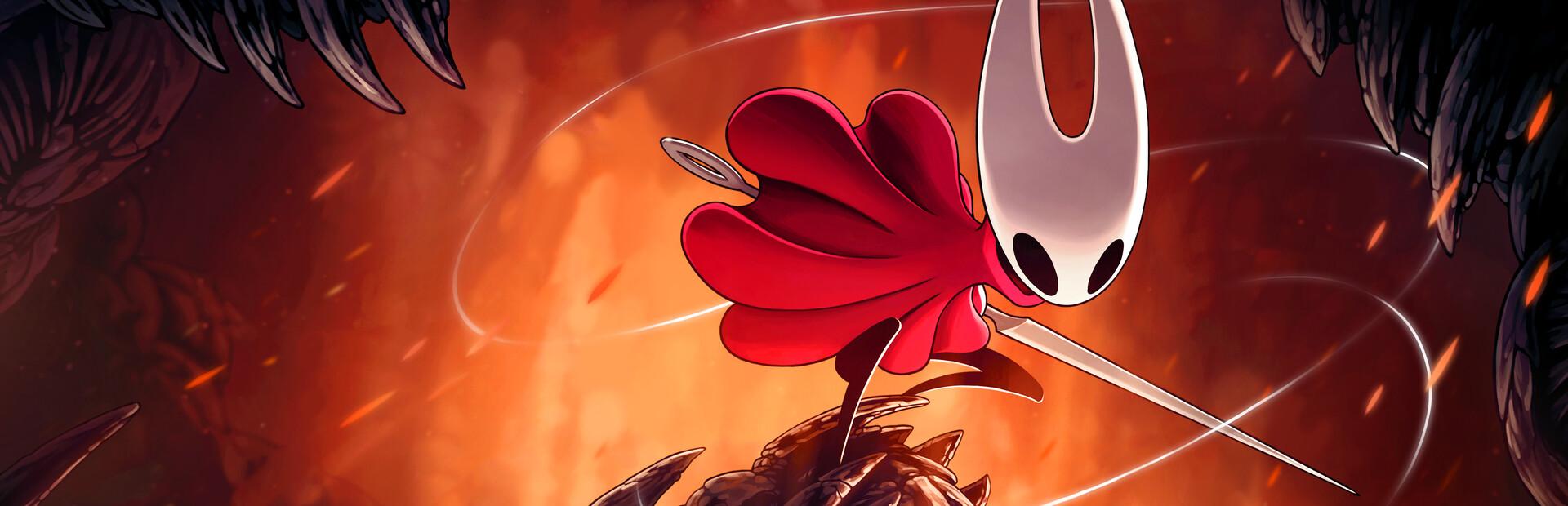
Hollow Knight: Silksong
Sixty-three hours, and the only real complaint is that it never once tells you which wall you were supposed to walk into.
PowerManiacWriter · Action, character action, soulslikesafter 63 hours
Team Cherry · Metroidvania · PC · released 04 Sept 2025 · Finished — 91% map, the longer ending, two of the optional bosses left standing
Played 58% longer than the game usually takes to finish.
Tested on Steam Deck OLED · native · locked 60 fps
This page went up in August with no score and fourteen hours behind it. It now has sixty-three, and the number arrives later than planned because Silksong kept being a different game than the one I had written about.
What I said at fourteen hours still holds: Hornet changes everything, and Team Cherry rebalanced every encounter around her speed rather than letting the extra mobility make anything easier. Enemies commit to longer combos. Arenas are taller. The first genuine wall arrived at hour three, which in Hollow Knight took closer to ten.
Pharloom does become a place
This was the open question, and the answer is yes — around hour twenty-two, later than the first game managed it, and more completely when it lands.
What changes is not the map but the way the map starts referring to itself. A shortcut you open in one region turns out to be the back door of a region you gave up on eleven hours earlier. The Citadel sits above everything and reframes the route you took to reach it. By the second half I was navigating from memory rather than from the map screen, which is the only honest test of whether a world is a world.
- Deaths
- 612
- Bosses beaten
- 38
- Map completion
- 91%
- Hours before I stopped opening the map
- About 31
The crests held up, with one caveat
The worry at fourteen hours was front-loading: three moveset-rewriting crests had already arrived, and the first game's late hours worked partly because it kept giving.
That worry was half right. The crests that arrive later are sidegrades rather than escalations — a different set of trade-offs rather than a bigger number — and two of them I tried once and never equipped again. But the escalation turned out to be in the rooms rather than in the kit, and that is the better place for it. By the last third the game is building encounters that assume you have chosen a crest and will live with the consequence, which is a more interesting kind of difficulty than a stronger attack.
Where it slips
The difficulty communication never improved, and sixty-three hours in I am no longer willing to read it as confidence.
Silksong does not gate anything. You can reach a boss twelve hours before the game expects you to, and it will let you fight it, and nothing in the presentation distinguishes "you are underpowered" from "you are playing badly". I lost an evening to an optional fight I was not supposed to find yet, learned its entire pattern, beat it, and received a reward scaled for someone who should have arrived much later. That is a story I enjoy telling and a design I cannot defend — the forty-minute version of it, which happened twice more, is just wasted time with no information in it.
The second thing is that the back half is genuinely punishing in a way the marketing never suggested, and the lack of any difficulty option means there is no honest way to recommend it to someone who loved the first game at its gentler setting. That is a defensible choice. It is still a choice with a cost, and the cost is a chunk of the audience who finished Hollow Knight and will not finish this.
A smaller one: several hidden passages are signalled by sound alone, with no visual tell. On a Deck with the fan spun up, I missed two of them entirely.
The verdict
Sixty-three hours, and about fifteen of those were spent somewhere I had not earned the right to be. It is the best thing in this genre since the game it follows, and it is harder, longer and less interested in your comfort than that game was.
The score took three months longer than it should have, and the reason is in the article above rather than in a note at the bottom: at fourteen hours I did not know whether Pharloom was a world or a corridor, and nothing but another forty hours was going to tell me.
Play it on a controller, do not look anything up, and accept that the wall is the point.
Accessibility
- No difficulty options; this is the design
- Full remapping including a dedicated dash button
- Several rooms rely on audio cues to locate hidden passages
- No subtitle size control in menus
Checked during play, not from a feature list. Tell us what is missing at hoursdeepcontact@proton.me and it gets added.
Score history
- 24 Nov 2026No score → 9.1. Published at fourteen hours without a score. Scored after finishing at sixty-three. The two open questions in the original draft are answered in the article rather than deleted — Pharloom does become a place, and the difficulty communication did not improve.
❦
Read next
 The Finals78 hours · 05 Aug 20268.2